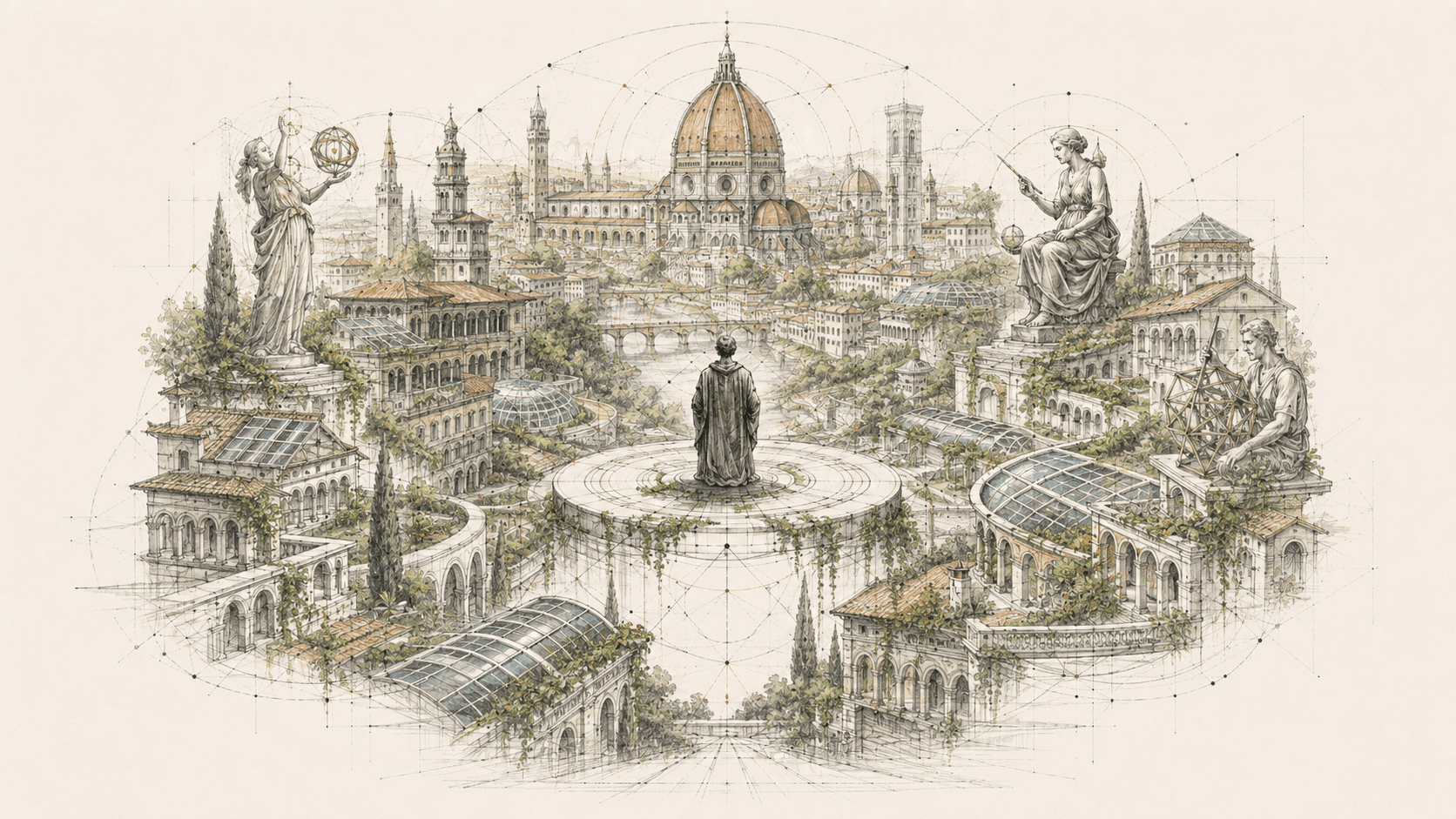
The Great Repricing
When intelligence becomes abundant, everything gets repriced. Execution falls toward zero, while the genuinely scarce — judgment, sovereignty, and sound money — is revalued upward.
By The SOV Ventures Team
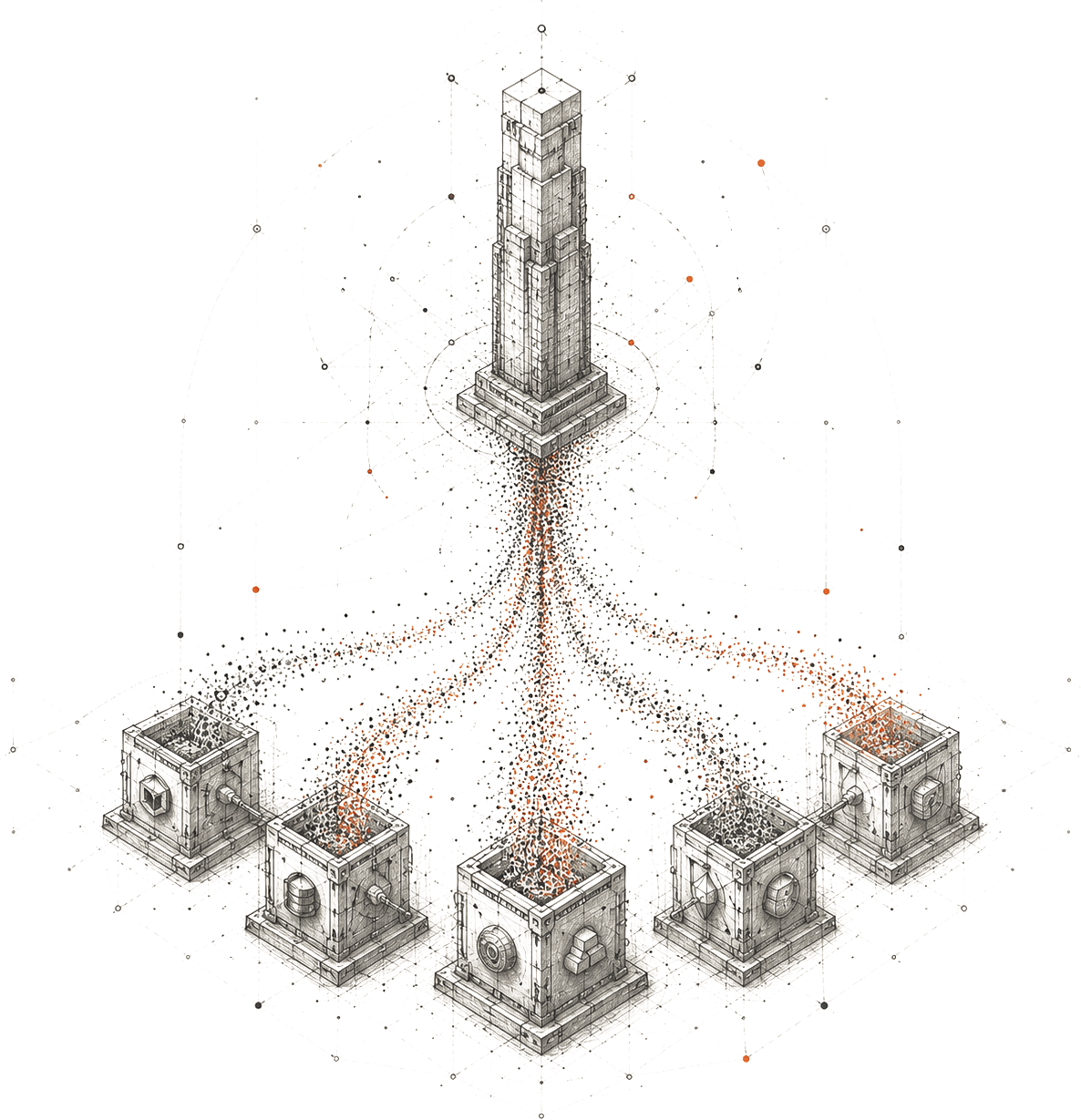
For centuries, the price of almost everything has rested on a single assumption: that human intelligence is scarce. Skilled labor, expert judgment, analysis, design, and management all commanded a premium because there were only so many capable people, and only so many hours in their day.
Artificial intelligence breaks that assumption. As the marginal cost of intelligence falls toward zero, the prices built on its scarcity begin to unwind. This is the great repricing: a systematic revaluation of nearly every asset, skill, and institution according to what remains scarce when intelligence no longer is.
Use Value vs. Scarcity Premium
To think clearly about this, separate two things. An asset's use value is the concrete benefit it provides—shelter from a home, output from a worker, returns from a business. Its scarcity premium is the portion of its price that exists only because the underlying capability was hard to come by.
AI leaves use value largely intact while collapsing scarcity premiums. A spreadsheet still models a business; a contract still binds. But the premium once paid for the scarce human who could produce them quickly is exactly what abundant intelligence competes away. The repricing falls hardest wherever price was a function of scarce cognition rather than scarce physical resources.
What Reprices Down
The first casualties are the assets and salaries that were really claims on scarce intelligence. Much of knowledge work—routine analysis, content production, first-draft legal and financial work, layers of management whose role was coordination—gets repriced toward the cost of running a model.
This does not mean the activity disappears. It means it stops commanding a premium. The capabilities that once differentiated firms and individuals become utilities, available to anyone with a prompt. When everyone can execute, execution stops being worth much.
What Reprices Up
Value migrates, as it always has, toward whatever stays scarce. In a world of abundant intelligence, several things become more valuable, not less:
- Judgment and taste—choosing which of a million machine-generated options actually matters.
- Sovereignty—ownership and control over your health, money, data, and security that doesn't depend on centralized systems.
- Sound money—credibly scarce monetary assets in a world where nearly everything else can be produced on demand.
- Energy and compute—the physical substrate that abundant intelligence ultimately runs on.
- Trust and high-agency community—relationships and reputation that cannot be synthesized.
Where Bitcoin Fits
Sound money is one corner of this repricing, and a useful one to make concrete. For most of history the monetary premium—the wealth people store in an asset purely to preserve it over time—has had to live somewhere: gold, land, bonds, prime real estate, increasingly equities. None of these were designed for the job; they absorb savings because there has been nowhere better to put them.
Bitcoin is interesting because it is the first asset engineered specifically to hold monetary premium: fixed in supply, globally portable, and impossible to inflate even by an intelligence that can spin up endless businesses, products, and copies of itself. An AI can generate millions of companies. It cannot generate more than twenty-one million Bitcoin.
As intelligence becomes abundant and credible scarcity becomes rare, some of the monetary premium stored in other assets is likely to migrate toward whatever holds it best. Bitcoin is one candidate beneficiary of the great repricing—not the whole story, but a clean illustration of the logic: when everything can be produced, the few things that genuinely cannot are revalued upward.
Repricing Is Not Collapse
Crucially, none of this requires a collapse of capitalism, real estate, or equity markets. Homes remain homes. Businesses remain productive. What changes is that fewer assets are forced to masquerade as savings vehicles, and fewer prices are propped up by the scarcity of human cognition.
Monetary and technological regime shifts historically unfold over decades, not quarters. The move from gold to fiat, and from the British pound to the dollar, each took roughly half a century. The repricing driven by abundant intelligence has accelerants those transitions never had—instant global distribution and software that compounds—but it will still play out over a generation.
Investing Through the Repricing
For investors, the great repricing reframes the basic question. The old question was "Will this asset generate returns?" The post-AGI question is "Is this asset's price built on a scarcity that AI is about to erase, or one it will deepen?"
A portfolio built for this world tilts away from claims on scarce execution and toward genuine scarcity—judgment-intensive businesses, sovereignty-preserving infrastructure, sound money, energy, and compute. This is not a price prediction. It is a structural thesis grounded in a single observation: when intelligence stops being scarce, everything priced on its scarcity has to be repriced, and the capital that recognizes this early helps build what comes next.