Why Agency Is Not Enough
AGI may massively increase what you can do while quietly reducing what you control. That gap, between agency and sovereignty, is the whole game.
By The SOV Ventures Team
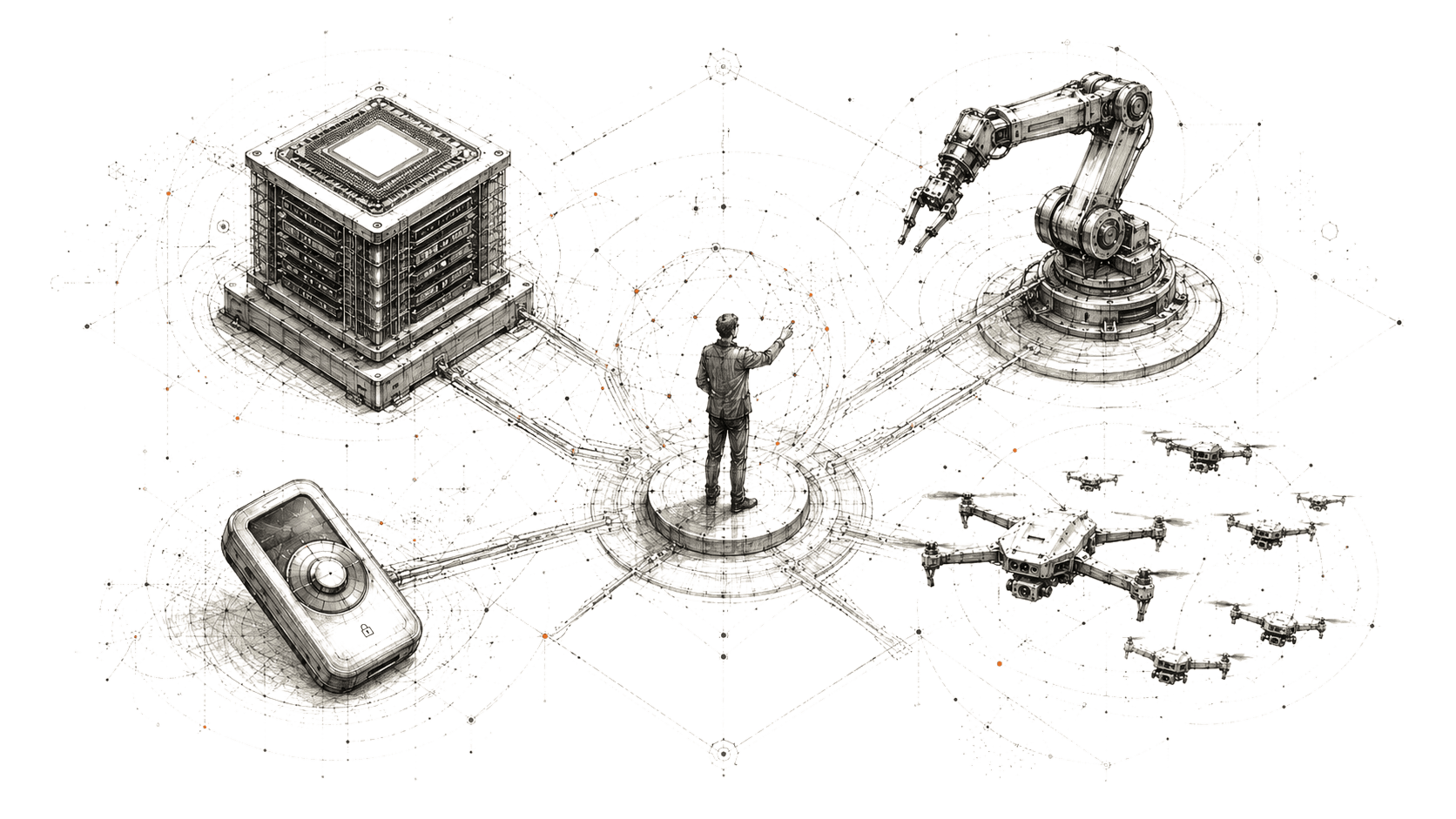
The hard truth about the next decade is uncomfortable: AGI may massively increase what you can do while quietly reducing what you control. That is the difference between agency and sovereignty, and it is the distinction that organizes everything SOV Ventures backs.
Most of the excitement about AI is really about agency—what one person will be able to build, research, negotiate, and ship. That excitement is justified. But it obscures a second question that matters more over time: when the system works beautifully, who holds the final veto?
Agency vs. Sovereignty
Agency is your ability to make choices and cause outcomes. It answers a simple question—can I act effectively?—and it covers the capacity to understand your options, form goals, make decisions, execute them, and change your environment.
AGI dramatically increases agency. A single person may soon operate at the level of today's large organizations: building a company, running research, managing investments, and producing media without a team.
Sovereignty is different. It is your ability to remain the ultimate authority over your life, assets, identity, and decisions. It answers: who has final control? Sovereignty is control over your data and digital identity, your money and property, the AI systems acting on your behalf, your access to compute and communications, the rules that govern your choices, and your ability to exit or switch providers.
Put plainly: agency is the power to act. Sovereignty is freedom from another party's veto.
Your Power Can Be Rented
Picture an extraordinarily capable AI assistant that runs your business, manages your finances, communicates on your behalf, makes purchases, and negotiates with institutions. You have enormous agency.
But the provider can suspend your account, change the model's behavior, inspect or monetize your data, block certain transactions, raise prices, or alter what the assistant is allowed to say or do. You do not have sovereignty. Your power is rented.
The reverse is just as real. You could own your data, run local models, hold Bitcoin, and control your own compute, yet lack the skills and tools to use any of it productively. That is sovereignty with weak agency. Ownership without capability is inert. Capability without ownership is dependency.
The Four States
Map the two axes against each other and four states appear:
- Low agency, low sovereignty: the powerless dependent—neither able to act nor in control.
- High agency, low sovereignty: the highly capable tenant—immensely productive on infrastructure someone else owns.
- Low agency, high sovereignty: independent but ineffective—holding the keys without the means to use them.
- High agency, high sovereignty: the sovereign individual—able to act at scale and keep the final say.
The most dangerous quadrant is high agency, low sovereignty. It feels empowering because everything works—right up until the provider, platform, state, or model changes the rules. That will likely be the default consumer experience of the post-AGI era, and steering people out of it is the point.
How the Layers Diverge After AGI
The gap between agency and sovereignty widens at every layer of the stack.
Cognitive: agency is access to intelligence that helps you reason, create, and execute. Sovereignty is control over the context, memory, objectives, and permissions that govern that intelligence. An AI can be smart enough to act for you without being loyal to you.
Economic: agency is the ability to generate income, allocate capital, and transact instantly. Sovereignty is holding assets that cannot easily be frozen, diluted, confiscated, or intermediated. An agent managing your bank account is agency; holding bearer assets and controlling the keys is sovereignty.
Data: agency is using your personal data to get better decisions and recommendations. Sovereignty is deciding where that data lives, who can touch it, and whether it can be deleted, exported, or used to train models. Personalization is not sovereignty if the platform owns the memory.
Infrastructure: agency is access to powerful models and compute. Sovereignty is having a viable alternative when a provider says no. One cloud account, one model company, and one identity provider is a life with no meaningful exit.
Political and legal: agency is the ability to advocate, organize, publish, and participate. Sovereignty is that no institution can arbitrarily erase your identity, assets, speech, or ability to transact. AGI strengthens the individual—but it can strengthen centralized institutions even more.
Agency Will Be Abundant. Sovereignty Will Be Scarce.
This is the strategic core, and it is the same thesis that runs through everything we publish. In the post-AGI world, agency becomes abundant and sovereignty stays scarce. Intelligence, execution, coding, design, analysis, and operational capacity will be available to almost everyone.
What stays constrained is control over compute, energy, capital, identity, networks, data, physical territory, and legal rights. So the real competition of the era is not over intelligence. It is over who controls the infrastructure through which intelligence acts.
A Practical Test
For any AI product, institution, or investment, we run two separate questions. The agency test: what new actions does this let a person take? The sovereignty test: can the person keep taking those actions if the provider, platform, government, or counterparty turns hostile?
Then the specifics:
- Can users export their data and memory?
- Can they switch models?
- Can they self-host?
- Do they own the outputs?
- Can the account be terminated at will?
- Is there a non-custodial option?
- Who controls the identity and payment rails?
- Is there a credible exit?
A system is not sovereign simply because it is decentralized, open-source, or encrypted. Sovereignty requires credible control plus credible exit. Both words carry weight.
What This Means for How We Invest
The biggest post-AGI opportunities may not be the applications that hand people more capability. Capability is becoming a commodity. The durable category is the infrastructure that keeps capability under human control:
- User-owned AI memory, with model portability and orchestration.
- Private computation and personal data vaults.
- Decentralized identity and censorship-resistant money.
- Local energy and compute.
- Autonomous legal and financial structures—tools that let one person operate as an institution.
This is the layer SOV Ventures concentrates on, and it maps directly onto the sectors we back—sovereign health and biology, wealth, data and compute, and security. In each, the question is not only what AI lets you do, but whether you stay in control while it does it.
Two formulas capture the whole thesis. Agency equals capability times execution. Sovereignty equals ownership times control times exit. AGI will hand nearly everyone the first. We invest in the people and the infrastructure protecting the second.